Showing posts with label Bandage Cube Kit. Show all posts

Tuesday, July 7, 2020

Introducing the Kiddos to Twisty Puzzles


From the bottom picture up we have Annie, Alex, Roriana, and David. Next time Annie and I are together we should revisit the Pyraminx Trignis! I wonder if she will remember what I told her about it back then? hahahahahaha!

I bet Alex could solve a cube now if he set his mind to it. I wonder if we could work on it together over Zoom.

What ever happened to that crinkly gold Fisher cube? It is no longer in my collection. Maybe one of the grandkids ended up with it, or maybe a young student somewhere along the line. Next time Roriana and I puzzle together it will have to be with something else.

David started out with one of my more complex puzzles! Maybe he should learn to solve a normal 3x3x3 before he revisits the 2x3x4 Camouflage cuboid!

Sunday, June 28, 2020

Bandage Cube

I have a Mefferts Bandage Cube and I have a CubeTwist Bandage Cube Kit. For the purposes of this experience I have bandaged the kit cube like the Mefferts cube except with Blue front, Yellow top, and Red right. This is not a cube that I ever sit down and refigure out or remember how to solve. So I started by looking up the Solution Guides pre Fall 2013
On the Puzzle_List page it says:
5—F' U L F U L' U2; 6—R U F R U' R2 F'; maybe ds; 8—(R U R' F') (U L' U' L) (F U'); maybe ds; 1—ds=(R U2 L' U) (R' U2 L U'); 743—(U2) (L F' L' F) (U') (R' F R F') (U')

What else have I said about the Bandage Cube in the past? A little over 3 years ago I posted a blog entry that referenced two other previous posts in different places. One was my Bandage Cube adventures from almost 9 years ago! And the other was from a couple years earlier! The blog entry linked doesn't just mention the other two posts. It looks like I copied them to the post.

Now, in the past I talked a lot about colors, which now I have changed. In the past I talked a lot period. Let's see if I can flesh out the above briefness without getting too detailed.

Somewhere along my puzzling adventures—maybe with the Bandage Cube—I wanted a way to refer to the 8 corners of the cube and I came up with 1 for FLU, 2 for FRU, 3 for FRD, 4 for FLD. Then 5 for BLD, 6 for BRD, 7 for BRU, 8 for BLU. 

Strategy
  1. Orient the Centers
  2. Corner 5 (Orange Green) F' U L F U L' U2. [ 14735 ] If OG is at 6 or 8 start with R U to get it into the cycle.
  3. Corner 6 (Red White) R U F R U' R2 F'. [ 38146 ] If RW is at 7 start with DoubleSwap to get it into the cycle.
  4. Corner 8 (Yellow Green) (R U R' F') (U L' U' L) (F U'). [ 178 ] If YG is not on top use DoubleSwap to get it there.
  5. Corner 1 (Blue Yellow) 
    • From 3 use DoubleSwap (R U2 L' U) (R' U2 L U') [ 13 / 47 ]
    • From 4 use 743 then DoubleSwap. 743 = U2 (L F' L' F) U' (R' F R F') U'
    • From 7 use 743 x 2 then DoubleSwap
  6. Corners 7 4 and 3 U2 (L F' L' F) U' (R' F R F') U'. [ 743 ]

Bandage Cube Scrambles
Thanks to James the "thebackflipmaster" for the following list of scrambles.

 x
R U R'F'U2L U'F'L F L'U'F U'R'F R2U2F'L'F'L'U L U  
 x U2L U'R'F2L F'R F2L2U'F R U'L U'F'L'U2F R U L'U2R' 
 x R U'L U'F2L'F U L'U'L F L'U2R U'L U2R'U2L U'F'U L2 
 
R U2F U'R'U'R'F R F'U'R U2F'L'U L2F U'R'F2L F2R'F2  
 
F'U L F U'R'F R2U R'F'R U F'L F L'U'L F2R'F'R'F L2  
 
R U R U2L'U R'U'R'U2L2F2R'F'R U F'L'U2R U'L U'F2L'  
 
R U2F U'R'U F'L'U L U2R'F R2U F2L'U L U'F'L F2U'R'  
 
U F2R F'U2R'U F R'F'R U R U F'U L U2R'F2L'F U L F'  
 x U F'L'U L U'F'L F U'F R2U2L'U2R'F'U F U'R'U F'L'U2
 x R U2F'L'U L U'F'L F U'F R U L'U R'U F U F R'F L'U' 
 x F'U L2F2R'F L'F2R F2L'F2R2U2L'U R'U'R'U2L F'L'U L 
 x U F2R F'U2R'U F R'F'R U R'F2L F'R F'U'F'U'R U'L F2
 x U F2R F2L'U2R'U2L F'L'U L U L U'F'L F L'U2F R F R'
 x F'U L2F2R'F L'F2R2U F2L'F U L'U'L F U L U'F2L'F U2
 x U2L U2R'F R F'U'R U2L'U2R U R'F'U2L2F L'U R'U F U'
 x R U R U2L'U R'U L F2R'F'R U F'L'U R'U2L2F U'R'F'R'
 x U2L F U'R'F R F2L2U2R U R U'L U2R2F2L F L F'R F2L2 
 x F R2U R'F'U2L U2R'F'U'F R2U R'F'U F U L'U'F U'R'F'
 x F R2U R'F'U F'L'U L U'F'L F L'U2F R U'R'U2L2F2R'F2
 x F R U F'L'U'R U'L U2R2F'U2L U'F'L F L'U'L F2R'F2L2
 x R U2F'L'U L U'F'L F2U'R'U L'U2F'U L2F L'U2R U'L F2
 x F R2U R'F2L F U'R'F'U F2R U F'L2U'L F U'F'U L2F2R2
 x F'U L U L F'L'F U L'U'F U'R'F'L F'R F'U'F'U'R U F2
 x F'U L2F'R F2L2U'F R U R'F'R'F'U2L U'F'L F L'U2F R
 x U2L F U'R'F2L'F R U2L'U'L F U2R'F R F'U'R U R'F2U
 x U2L F U'R'F R F'U'R U2F'L2U2R U'L U2R2F2L F'R F'U2
 
F R2U R'F'R U2L'U R'U L F U'R'F'U L'U2R U R U'L U' 
 
F R2U R'F'U'R'U L'U2R U2L F U2R'U F R'F'R U F'U2R'  
 
F R2U R'F'R U2L'U R'U L F U2R'U F R'F'R U2F'L'U2R'  
 
F R U'R'U F R'F'R U2F'L'U L U2R'F R U F'L'U L U2R'  
 
F'U L U'F R2U R'F'U L F L'U R'U2L F'L'U L F'L'F U'  
 
F R2U R'F'R U2L'U R'U2L U2R'F'U L2F2R'F L'F2R2U F2  
 
U2L F'L2U'L F2R'F'R U F'L F U2R'F R2U F2L'U'F R U2  
 
F'U L2F2R'F L'F2R2U F'L F L'U'L F2R'F L2U'F U F'L'  
 
F'U L2F'R F2L'F U'R'F'U'R U R'F'U2L F'L'F U L'U2F'  
 
F'U L U L F'L'F U L'U'L F L'U2F R U'R'U F R'F'R U'  
 
U L'U2R U'L2F U'R'F2U'F R2U R'F'U L F L'U'L'U'F2R'  
 
F'U L2F L'U2R U R'F'U F'L'F2R U F U'R'U F'L'U'R U2  
 
U L'U2R U R U'L U2R'F'U L F U L'U R'F R2U R'F'R'F'  
 
R U'L U'F'L'U'F2R U'R2F'U F R'F'R U F'L'U'L F'R F  
 
U F'L'U L U L U'F'L F L'U'L F'R F2L2U'F R'F'U F2R  
 
R U R'F2L F2U F U'R'F R F'U'R U F'U L F'L2U2F R U  

The x above indicates the ones I either did years ago or today. I did several today (June 28, 2020). I thought as I did them I would rely less and less on the notes above, but it ain't happenin'. I'm about ready to put it away for now. At least I have it all set for the next time I want to play with it. Next month? We shall see.

Monday, August 3, 2015

Bandage Kit Cube

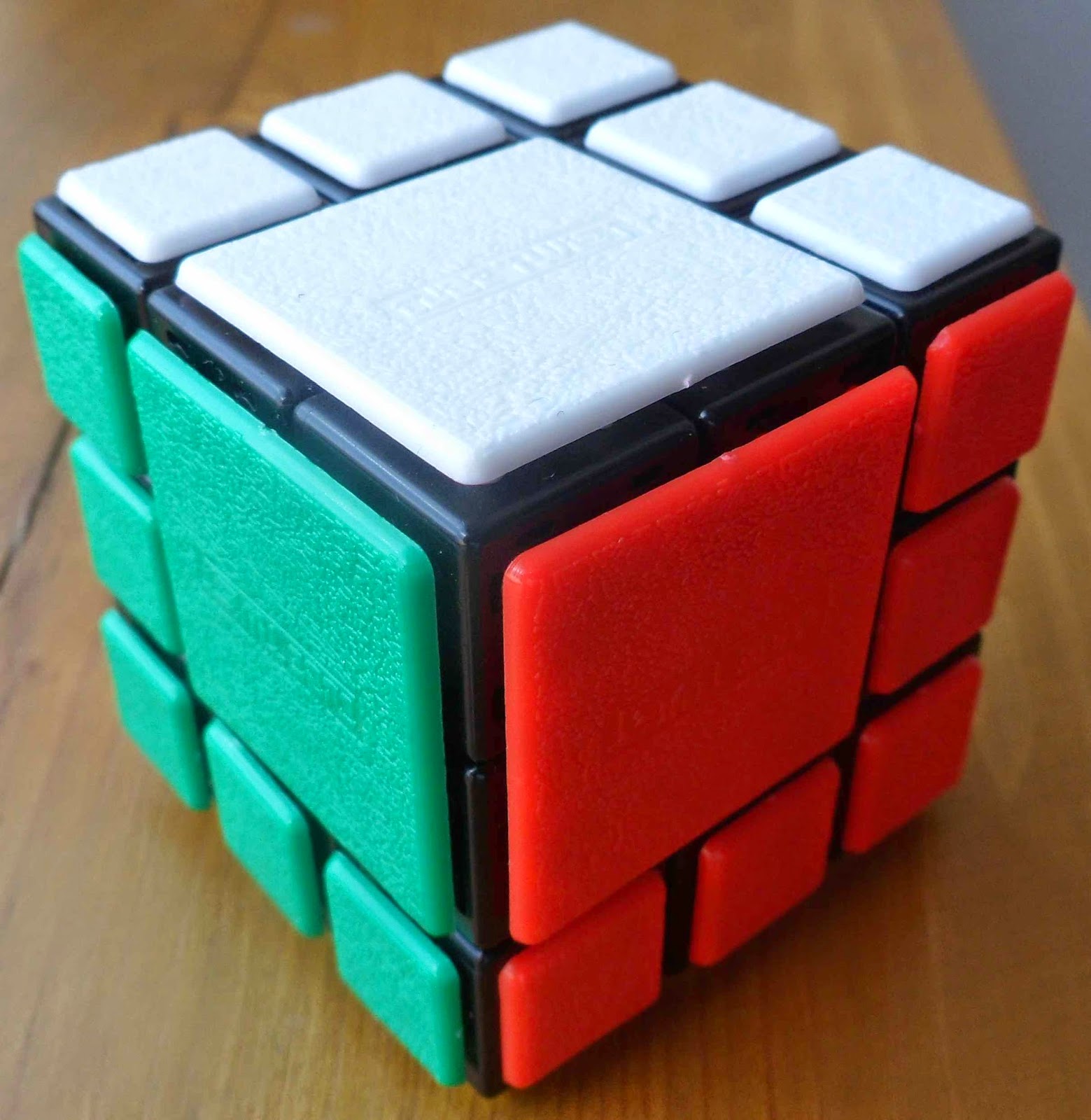
I wanted Annie to play with a corners only cube. She had ideas of her own. Pretty soon it was covered with tiles so big it wouldn't turn. We made some slight adjustments and two sides would turn but each blocked the other. After further modifications one layer has two positions that do not block the other turntable layer. And the other does no blocking as it is made up of all 1x1x1 cubies. 

It does not scramble very much. The Move and Sune can both be done so it is easy enough to solve the 5 edges. The Move X 3 can be used to do double swaps of edges to permutations the edges. It was challenging to come up with a corner twister for me and the ones I have come up with are pretty long. 

At first I could only find ways to twist four corners. I wanted to be able to twist two corners, so I didn't keep track of how to twist four. Now I can twist two, but usually during a solve four or five need to twist once the edges are solved and corners permuted. 

A discovery (rediscovery?) made last night is that the edge swapper routine I learned once upon a time done twice in a row does a double swap of corners. Combining that with The Move X 3 twists two corners. Specifically (U R U Ri U R U Ri U) (U R U Ri U R U Ri U) U (R U Ri Ui) X 3 Ui twists FLU anti and BLU clock.

Another way to twist two corners uses Sune. (R U Ri U R U2 Ri U) X 2 R U2 (Ui Ri U R) X 3 U2 Ri twists FRU anti and BLU clock.


Thursday, August 7, 2014

Bandage Cube Kit—Cross Road Cube

We traveled from Prague to Sacramento on the 5th of the month. Along the way I worked on the Cross Cube and documented the adventure in a binder. Here's the story—

A lot like the Meffert's Bandage Cube, or the Bicube, only the 2x2x2 block of pieces diagonally opposite the 1x1x1 of the Bicube is unbandaged, so is indeed more 2x2x2 ish.

Since I have had the Meffert's cube for a long time and am somewhat familiar with the screwy color scheme he used, I tiled the Cross Cube to match, so as to avoid any confusion.

On the first scramble the blue-white and orange-white edges fell into place as I oriented the centers. The big challenge was pairing up the blue-orange-white 2x1x1. After that I solved it as the Bicube with no problem.

On the second scramble I made sure each piece was scrambled. Getting the 2x2x2 corner was somewhat challenging but I finally got it and went to my Bicube solve. All was going well until I got to what should have been the last step—the 743 3-cycle. But instead, 7 and 3 had to swap and flip. Huh?!?

Figuring it had something to do with the 2x2x2 corner, I used it to twist one of the pieces to the other one. Things were pretty messed up so I re-solved and 7 and 3 were no longer swapped. 7 and 8 were! But at least they weren't flipped. :D

Decided on a new approach. Point greens down since with the little ones on the blue side they could be pointing back without pointing them back. Then put the 1x1x1 on top on the left and do a mirror solve. By the time I did what I could do, I put the greens at the back and fixed the top and... found 3 and 6 were swapped.

Tried something else—don't remember what—ended up needing a 4-cycle, which is not any better than a swap. So I did a 5-cycle to see what would happen. 4 and 6 were swapped. Did the place #5 algorithm. It then needed a 6-cycle. Did it repeatedly, and it just cycled through a bunch of 6-cycles until it came back to the single swap.

A little background. I got up at 4 AM in Prague to get ready to go to the airport and fly home. We flew to London. Had a several hour layover. Flew to Dallas. Had an even longer layover. On the flight to Sacramento I wrote:
Altogether it has been a very long day. In Dallas I scrambled the 2x2x2 corner and couldn't get it back. During the biginning of the flight to Sacramento I tried and failed and was getting frustrated. Being awake for 24 hours may or may not have something to do with it.
After forcing down a can of Ginger Ale I tried to sleep. I slept some although I dept waking up. Finally I decided to get the cube out, solve it as much as possible, then retile the pieces I couldn't solve. But instead of the red-yellow-green corner, I was using the blue-white-orange one as the #2 corner. After several tries through the #5 routine I noticed the blue-white-orange had twisted and was paired up perfectly with the blue-white edge. I put them home. Then #6, #8, and #1. I don't think I had to cycle 743. It was solved! No pair swapped! Somewhere in the trying to solve the 2x2x2 corner I suppose, I remedied the swap problem. 

Played around with it for a bit more. Somehow twisted #2 clock and #8 anti. All else was still solved. How? I had an idea, but hadn't written it down. Started writing. 

Fi U L F U Li U2 (#5)
F R U Fi Ui
Fi U L F U Li U2 (#5)
Ri
Fi U L F U Li U2 (#5)
Double swap; 743; double swap; 743 x 2

The above twists #2 anti and #8 clock.

I still do not know how to systematically fix the situation in which 2 pieces need to swap.

August 7, 2014
Today I saw that
Fi U L F U Li U2 (#5)
F R U Fi Ui
Fi U L F U Li U2 (#5)
Ri
Fi U L F U Li U2 (#5)
times two twists #2 clock and #8 anti. Can that be?

And after more experimentation and solving, I finally scrambled it in such a way that I got the single swap again. And still have no idea how or why or what to do about it.

August 8, 2014
OK. I have an idea. An intelligent guess. From solved I did R Bi Ri. That took the orange-white edge out of place. Then I tried to keep track of things but got hopelessly lost eventually, but managed to get the orange-white edge back home without turning B 90°. Upon solving the cube from there, I ended up with 2 swapped pieces, 3 and 4. I just don't have a nice neat algorithm for doing it. I think the single 90° turn of B key to the single swap situation. It isn't polished but I got something.

R B Ui L Ui Fi L D2 L2 does a 90° turn of B then restores the blue-orange and white-orange edges. It wasn't easy to unlock the resulting bandages on F and R, but eventually got it and solved the puzzle! Yay!

Sunday, August 3, 2014

Bandage Cube Kit—Double Block Clock

The Sune Thing (TST)
Green on Right; Yellow Up
R U Ri U R U2 Ri (DE)2 Ui L Ui Li y2

Everything else is done with Green Up; Yellow on Right

Corner Twisters (edit 8/12/14 below: a better way found)
CT#1
2, 3, 6, 7 anti; 8 clock
(TST)—R (R U Ri Ui) Ri—(R U Ri Ui)x3

CT#2
2, 8 clock; 3,7 anti
(TST)x2—R (U R Ui Ri) Ri—(R U Ri Ui)x3—R (R U Ri Ui)x3 Ri—(R U Ri Ui)x3

CT#3
2, 7 clock; 6,8 anti
(TST)x3—(R U Ri Ui)x3—R (R U Ri Ui)x3 Ri—(R U Ri Ui)x3—R (U R Ui Ri)x3 Ri

CT#4
2, 3 anti; 6, 8 clock
(TST)x4—R (R U Ri Ui)x4 Ri—(R U Ri Ui)x3—R (R U Ri Ui)x3 Ri

CT#5
2, 3, 6 anti
CT#3—CT#2

CT#6
3 anti; 6 clock
CT#3—CT#1

CT#7
2 anti; 6 clock
CT#3—R (R U Ri Ui) Ri—CT#2—R (U R Ui Ri) Ri

CT#8
3, 7 clock; 6, 8 anti
CT#2—CT#1

So far I've solved it once. I forget now which CT I used at the end. I'd like to do multiple solves and keep track.

August 4, 2014
It is really pretty simple to solve all the edges, even if they need flipped. Permuting the corners hasn't been a problem either. It is orienting the corners that can be difficult. Got down to needing to twist 2 and 8. Twisted 2 and 6, then swapped 28 and 36, then twisted 2, 3, and 6. I finally ended up needing to twist 2 and 6, which I could do. Something like that.

August 12, 2014
In spite of what I said on the 4th of the month, I was not able to flip edges today when I tried to solve Double Block Clock, until I looked at the flipper for Double Block. Here is how it plays out for DBC:

Flipping Edges—R (U2 L F Li U2) Ri (U2 L F Li U2) (U R2 Ui R2) flips UB and UR and double swaps some corners.

Twisting Corners—Doing the Edge Flipper twice twists 2 anti and 3, 6, 7, and 8 clock.

Twisting 2 anti and 3 clock the easy way—((R Ui Li B L U Ri) (R U Ri Ui)) x 2 (R U Ri Ui) x 3

August 14, 2014
Although I found an easier way to twist corners 2 and 3 a couple days ago, it still isn't so easy to access all the corners that may need twisting. So I kept experimenting along the same lines—

Twisting 2 clock and 3 anti—((R Ui Li Bi L U Ri) (U R Ui Ri)) x 2 (U R Ui Ri) x 3

Twisting 3 anti and 6 clock—(R2 Ui Li B L U2 Ri Ui Ri) x 2 R (R U Ri Ui) x 3 Ri

Twisting 2 clock and 8 anti—(R2 Ui Li Bi L U2 Ri Ui R U Ri Ui Ri) x 2 R (R U Ri Ui) x 3 Ri

It is a simple thing to swap 2 with 3 and 7 with 8, so it would be a simple setup to twist 3 and 7.

It is a simple thing to swap 3 with 6 and 2 with 8, so it would be a simple setup to twist 6 and 8.

This covers 5 of the 10 pairs of corners that may need twisting. But of course each of these twists a pair in opposite directions. I'm thinking that in combination with the Edge Flipper Corner Twister ... I don't know ... many actual combinations could be dealt with. But I wonder how many others could not.

August 15. 2014
An endgame: The green-yellow and orange-yellow edges were swapped and the corners were in a 4-cycle. B 90° turned the swap into a 3-cycle, but, of course, one of the edges was the blue-red. So I had to move something that wasn't part of the 3-cycle into BD to replace it, do the 3-cycle, then move the blue-red back. A lot of edge-flipping was needed too, including the blue-red, so it got moved out, flipped, and moved back in again. When finally the edges were all solved, 5 corners needed permuted. Two quick Triple-EPS left me with all of them permuted, and 2 needing to twist anti and 8 clock. I used an EPS to swap them, then did the 2 clock 8 anti twister, then undid the setup move. Done.

Another endgame: Similar situation with edges, but this time I tried to make fewer trips in and out of BD, doing the cycle and flip during one trip. When all the edges were solved, corners 3 and 8 needed to swap, and corners 6 and 7 needed to swap. A Sune, Triple-EPS, Antisune permuted them, leaving 6 needing a clockwise twist and 8 an anti twist. I twisted them, but the wrong way, so did it again, but messed up somewhere—I think on the UR EPS. After re-solving the edges, it needed a 26 37 double swap. Several Triple-EPS later the corners were permuted and 3 needed to twist clock and 6 anti. I set them up with a swap, did the 36 twister, and undid the setup.

In both of the solves above, getting to the endgame required moving the red-blue piece back home without a simple B 90° move, as that would put it back into a single swap of edges scene. I used R Ui Li B L U Ri to move it out. But is there any reason I couldn't use Ui L2 D L2 U instead?

Friday, August 1, 2014

Bandage Cube Kit—Double Block

Double Block is another one of Burgo's creations. On October 28, 2012 he posted:
OK, Mildly Addicted here :oops:
I thought I'd make an easy one.. turned out to be `a little tougher` than I first thought. *Warning* this one's trouble :wink: . I called it the Double Block.. for more than one reason. My method for this one is a little scrappy at present, see what you think.
He listed it as Difficult, and added another bandage, calling it Double Block Clock, which he listed as Very Hard. I don't know about Double Block Clock yet, but Double Block fell together nicely for me. I wonder if there is something in the scrambling that I am missing that would make it more difficult. I don't think so, but if someone would like to challenge me with a Double Block scramble, I'd me more than willing to try it out.

With the two blocks solved and Green Up and White on the Left, the 5 corners, and 5 of the 7 edges are easily permuted with moves of R and U. My main algorithms?

1. (Ri U R Ui) x n and (R U Ri Ui) x n where n is an element of {1, 2, 3}. In other words, EPS, Double-EPS, and Triple-EPS.

2. Ui L2 D L2 U moves FD and BD into U and R.

3. (R U R Ui R U R Ui R) swaps UR and UB and cycles 4 corners.

4. (R U Ri U R U2 Ri)—Sune— works with Yellow Up and Green Right, but in my solves so far I haven't used it to move edges.

5. I haven't come up with, or needed, a 3-cycle of corners. The 3 double swaps have been adequate for permuting corners.

6. Twisting Corners—to me, this is what puts this puzzle in the Difficult range. First, I'll give the algorithm, then I'll explain how I came up with it.

Twisting 6 clock and 7 anti Steps
1. Hold Yellow Up and Green on R.
2. ((Right-hand Sune) (DE)2 L (Left-hand Sune) Li (DE)2) x 3
3. Hold White on Left and Green Up.
4. (R U Ri Ui) x 3
5. (Ri U R Ui) x 3

No long, complex, unfamiliar sequences at all! But how did I come up with that process? Well, I knew I could use Sune with Yellow Up and Green on the Right. I knew that because of the 2x2x1 block I couldn't use the Sune/mirror method of twisting corners simply. But what did I have to lose. Figured I would try to do something like it and see what happened. I did it 3 times to preserve the edges. After step 2 I went back to White on the Left and Green Up and looked at the corners. I saw that corner 2 (FRU) needed to go to 3 (RFD) so I did the Triple-EPS that would do that. Then I looked at the corners and saw that 2 and 7 (URB) needed to swap, and 6 (DRB) and 8 (ULB) needed to swap, so I did the Triple-EPS that would do that. Then I looked at the corners and noticed that 6 twisted clockwise and 7 anti-clockwise. Golden. :D

August 3, 2014
Oh no!!!! I was afraid it couldn't be that easy. After having such an easy time "figuring out" Double Block, I moved on to Double Block Clock. The Clock part made it impossible to twist corners as with Double Block. So I was exploring different things I could do with it, and discovered a whole new way of scrambling Double Block that does funky things like flipping edges. So no more DB Clock until I have a go at the revisited Double Block with new twists and turns not covered on the first go round.

7. Flipping Edges—(U2 L F Li U2) Ri (U2 L F Li U2) R flips UB and RB and restores FD.

Tuesday, July 29, 2014

Bandage Cube Kit—Pendulum

Andrea of Germany came up with this one and posted it on the twistypuzzles.com forum back in November 2012. Burgo rated it as difficult. I confer. I've given it three good scrambles. On the first one, after getting down to needing a corner 3-cycle to finish up, I retiled for further analysis. After coming up with some more corner 3-cycles and a way to flip edges and twist corners, I solved it completely a couple times. The last time I had to flip all 4 edges and twist 5 corners at the end.

After solving the bandaged pieces, I placed the edges. It is an easy task and seeing which ones that need to flip is so much easier for me when they are in place. Using 90° turns of the white bar and the red bar, pairs of edges can be flipped. More specifically, with orange up and yellow on front, M2 (F U F2 Ui F) (Ri F2 R F2) M2 flips UR and FR. It also 5 cycles corners. The first (section) does the flipping, and the second (section) puts them back in place. During the solve I don't really put the edges at UR and FR and do the algorithm. It doesn't really matter which side the one on top is on, and it doesn't matter which side the one on bottom is on. Turn the one on bottom that needs flipped down with either F or Fi. Turn the one on top that needs flipped to UF. Swap them with F2 and they are flipped when the bandaged pieces are put back home. After the edges are flipped and solved the hard part comes—the corners.

During the experimentation and analysis stage I came up with 4 key sequences that can be used to solve the corners. I'm thinking that perhaps with further work the method could be refined and simplified, but I'm ready to move on. Annie wants to help me tile a new puzzle. :D

S1: M R U2 Ri U2 Mi = FR > UR > UL; 18327; x3 pure cycles 12873; doesn't move 4
S2: M Li U2 L U2 Mi = FL > UL > UR; 18274; x3 pure cycles 17842; doesn't move 3
S3: M2 Ri F2 R F2 M2 = UR > FR > FL; 14723; x3 pure cycles 12437; doesn't move 8
S4: M2 L F2 Li F2 M2 = UL > FL > FR; 14238; x3 pure cycles 13482; doesn't move 7

In practice you don't have to do all the M moves between sequences of these cycles. Just move the white bar either to the top or front, wherever it is needed.

Stringing these together in different combinations yields pure corner 3-cycles. After doing the first two, choose the third one by seeing what needs to happen to restore the edges.

S1, S2, S4 cycles corners 1 > 3 > 7
S1, S3, S2 cycles corners 1 > 2 > 7
S1, S4, S3 cycles corners 1 > 4 > 3
S2, S1, S3 cycles corners 2 > 4 > 8
S2, S3, S4 cycles corners 2 > 3 > 4
S2, S4, S1 cycles corners 1 > 8 > 2
S3, S1, S4 cycles corners 1 > 2 > 3
S3, S2, S1 cycles corners 1 > 8 > 7
S3, S4, S2 cycles corners 1 > 7 > 3
S4, S1, S2 cycles corners 2 > 7 > 8
S4, S2, S3 cycles corners 1 > 4 > 2
S4, S3, S1 cycles corners 2 > 8 > 4

When looking for the edge flipper I made a happy little discovery.

M2 F U F2 Ui F S3 S2 S3 S4 S1 S3 S2 Mi. Of course there are M moves between the sequences when necessary. What does this do? It flips UR and UF, and it twists corner 3 clockwise and corner 7 anti-clockwise. That means if you do the whole thing twice the flipped edges get unflipped and the corners get twisted again, so the net result is to twist 3 anti and 7 clock. Granted, it is a lot of work to twist a couple corners, and if the corners aren't at 3 and 7 it requires some crazy setup moves, but it worked. Perhaps someday I will look at Pendulum again and find a better way.

July 31, 2014
Burgo gave me some feedback on the forum, so I went ahead and looked at his solution method. He used a commutator to cycle corners home Domino style. That meant he had to orient the corners before permuting them. This inspired me to do some more experimenting in two areas. Orienting corners, and cycling corners. It led to a Pure 3-cycle for Edges that I will probably never use. I don't know. It might be useful during the orientation phase if I translate it into Orange Up Yellow Front twists. Here it is:

M (U2 R U2 Li U2 Ri U2 L) x 2 Mi cycles FL > UL > FR without scrambling corners.

M ((U2 R U2) Li (U2 Ri U2) L) x 3 Mi does a double swap of corners. 14 and 38.
M ((U2 Li U2) R (U2 L U2) Ri) x 3 Mi does a double swap of corners. 23 and 47.

Holding Yellow Up and Orange Front gives even more possibilities. 27 and 38, and 18 and 47. These numbers are from the point of view of Orange Up and Yellow Front.

As far as the orientation goes, the same technique that flips edges also twists corners. With M2 F U F2 Ui F, Corner 3 twists clockwise and moves to 7. Corner 7 twists anti and moves to 1. The edges adjacent to the corners are the ones that flip. The corner edge pairs swap during F2. Different combinations of F and U can result in different corner edge pairs being reoriented.

Of course, all of this orientation of corners is based on the fact that the moves for placing them do not change the orientation. How do I know if an edge or a corner is oriented correctly before it is placed? With Orange Up and Yellow Front, Blue and Green are on the left and right. The edges and corners without blue or green on the left or right need to be flipped or twisted.

The pure edge flipper and corner twister that I gave a couple days ago can be shortened to simply orientation sequences if you don't care that the pieces move around. I suppose the best case scenario is when two edges need flipped and two corners twisted and you can easily arrange them so that doing one F U F2 Ui F orients them all at once. If no edges need to flip and four corners need to twist, the following sequence will twist 1 and 7 anti and 3 and 4 clock.

((F U F2 Ui F)(Ri F2 R F2)) x 2

And doing it x 4 instead of x 2 twists only two corners: 2 anti and 4 clock.

I'm thinking that a good strategy of solution would be to solve the bandaged pieces first, then with Orange Up and Yellow Front proceed. Orient all the edges and corners. Permute the edges. Permute the corners.

If I were planning to solve this particular puzzle on a regular basis, I might want to master Burgo's method of permuting corners at least, if not also his way of orienting them. 

Saturday, July 26, 2014

Bandage Cube Kit—Bandaged Fortress

In October 2012 Burgo posted on the twistypuzzles.com Bandage Cube Kit thread: 
The Bandaged Loop above won't prove too much of a challenge to the experienced solvers. So I made a version in which I sought to block known sequences. It looks like a castle so I called it the Bandaged Fortress.
Block known sequences is right! It wasn't too hard to come up with some sequences which make for double swaps of edges, and a couple useful 3-cycles. And I noticed that the corners couldn't scramble at all. And it seemed that edge-flipping was not an issue either.

But I had trouble scrambling it. The only way I had to scramble it was to use the sequences for solving. That made for nice neat scrambles. I needed more. A trip to the twistypuzzles.com Bandage Kit thread revealed a very nice scrambling sequence that Andrea came up with back in November 2012.
I found a nice way to scramble the bandaged fortress :
Top face is white, front face is red
( the fortress looks like a table)
Turn the following sequence one or more time.
Replace the 'x' with 1 or 3.
e.G
Rx (replacee with => 1 = R)
Rx (replace with 3 => R3 = R' )
Now, the sequence :
L2 B U2 F2 Dx R2 D2 Rx F2 R2 Fx D2 F2 Dx R2 U2 Lx B2
each x can be replaced with different numbers.
Easiest case: replace all 'x' with 1
L2 B U2 F2 D R2 D2 R F2 R2 F D2 F2 D R2 U2 L B2
It scrambles the cube very much.
It's not recommended, trying to solve the fortress with this sequence !
Much fun with a good scrambled fortress.
Cheers,
Andrea
This opened a can of worms for me. My first scramble using this sequence flipped lots of edges! I decided not to look at Andrea's scrambler any more lest it give me any hints about how to flip edges. In setting out to develop an edge flipper I kept coming up with a sequence that totally scrambled the cube. I just could not think of any other way to flip edges. Finally I decided to solve the scrambled cube, and, lo and behold, when I got everything permuted, 4 edges were flipped. I tried several slight modifications, but always came out with 4 flipped edges.

What could I do? I used Andrea's scrambler to scramble the cube, then permuted all the edges. 4 needed flipped, so I used my edge flipper algorithm, taking by faith that it flipped the edges while remixing everything up. Then I solved it, and indeed, it worked! I tried her algorithm again only going through it twice before starting my solve. Same idea—permute everything, see what needs flipped, flip 4 edges, permute everything again. This time I had to use other algorithms to move the 4 edges into place before flipping them. It worked.

Then I took a good close look at Andrea's scrambler. It is identical to my edge flipper algorithm!

My Algorithms
AR01: (R2 F2) x 3 double swaps edges UF < > DF and UR < > DR
AR02: R2 F (DE)2 F2 D2 F2 (DE)2 F R2 double swaps UR < > DL and UF < > DF
AR03: AR02 followed by AR01 3-cycles DL > DR > UR

AL01: (L2 F2) x 3 double swaps edges UF < > DF and UL < > DL
AL02: L2 Fi (DE)2 F2 D2 F2 (DE)2 Fi L2 double swaps UL < > DR and UF < > DF
AL03: AL02 followed by AL01 3-cycles DR > DL > UL

AR04: R2 F (DE)2 F2 D (R2 D2) x 2 R2 Di F2 (DE)2 F R2 3-cycles FU > FD > FR
AR05: R2 Fi (DE)2 F2 D (R2 D2) x 2 R2 Di F2 (DE)2 Fi R2 3-cycles FU > FR > FD

AL04: L2 Fi (DE)2 F2 Di (L2 D2) x 2 L2 D F2 (DE)2 Fi L2 3-cycles FU > FD > FL
AL05: L2 F (DE)2 F2 Di (L2 D2) x 2 L2 D F2 (DE)2 F L2 3-cycles FU > FL > FD

AR06: R2 F (DE)2 F2 D R2 D2 Ri F2 R2 F D2 F2 D R2 (DE)2 Ri F2 flips UR DR DL and FR
AR07: R2 F (DE)2 F2 D (R2 D2) x 4 Ri F2 R2 F D2 F2 D R2 (DE)2 Ri F2 flips UR DR DL and DF

AL06: L2 Fi (DE)2 F2 Di L2 D2 L F2 L2 Fi D2 F2 Di L2 (DE)2 L F2 flips UL DL DR and FL
AL07: L2 Fi (DE)2 F2 Di (L2 D2) x 4 L F2 L2 Fi D2 F2 Di L2 (DE)2 L F2 flips UL DL DR and DF

Andrea's Scrambler (translated to my puzzle orientation)
R2 F (DE)2 F2 Dx R2 D2 Rx F2 R2 Fx D2 F2 Dx R2 (DE)2 Rx F2

I am reasonably sure I could solve this puzzle using my algorithms no matter who scrambled it,  but I'm not saying it would be easy. For example. On a solved cube I did Burgo's edge flipper. It was a pure double swap of edges that somehow flipped two of them. Nice. So with one double swap done I solved the cube and ended up with two flipped edges at DL and DB. This solve turned out to be slightly easier than the solves from totally scrambled, but still took some work. Now to flip just two edges what I need to do is flip 4 edges including only one of the two that need to flip. Then I'll flip the other one along with the same three. That should do it. It works, but oh my! What a lot of work to accomplish one double swap.

July 27, 2014
When I think of flipped edges, I think of, well, edges that are flipped! Like the blue yellow edge is flipped if when permuted the blue is on the yellow side. Simple. And in the Petrus Method I know how to tell good edges and bad edges and equate bad edges as being flipped, and know how to flip them. But when Burgo says that swapping two adjacent edges on U flips them even though the U color is still on U—huh?!? I think I've seen him explain this in a video once, but it was long ago, and I didn't have any reason to remember it. But today, upon reflecting on it, here is what I came up with, and it seems to work on the Fortress. After scrambling the puzzle using Andrea's scrambler, look at each edge. Imagine it being on an unbandaged cube and using twists of R, F, L, and B, mentally take it home. If it is flipped when it gets home, then it is flipped. Using this idea to flip the edges before solving the puzzle has made for some nice easy solves. Perhaps because my edge flipper algorithm is so similar to Andrea's scrambler algorithm. Maybe.

One more thing. Burgo's 2 edge flipper algorithm, when translated to my solving perspective, is very similar to my other algorithms.

Wednesday, July 23, 2014

Bandage Cube Kit—Bandaged YZ Family

I don't know why exactly, but I like this configuration a lot. It is just fun to play with. Maybe it is the three 2x2x1 blocks. Maybe it is because edges can be solved with EPS and corners permuted with Triple-EPS, and oriented with Sune/Mirror. Perhaps because although setups are needed to get around the bandaging, they are not overly complex. There is just something about the feel that is enjoyable.


After a couple solves I decided to share my enjoyment of this puzzle on the twistypuzzles.com thread. I noticed that Burgo listed the Bandaged YZ as a difficult puzzle. I couldn't believe it. So I checked the pictures and noticed that the three little tiles across the middle of the green side are supposed to be one long tile. Maybe I should graduate from my very simplified one to his Unbandaged one before attempting the terribly bandaged one!

Burgo's Unbandaged YZ (below) didn't seem difficult either, although he lists it as difficult. Perhaps I should have scrambled it and solved it several times to see if there were any hidden surprises. But the blue and white faces could be turned from the get-go so 3 of the 5 edges and 4 of the 5 corners that need to be solved are easy to handle. And turning the blue face 180° makes the orange yellow corner edge pair easily accessible. Furthermore doing blue' yellow' puts all little ones on top in such a way that all manner of EPS and Sunes can be done. I even had to swap two edges and it was no problem at all with my standard edge swapper algorithm—U' R U' R' ....


At first Burgo's Bandaged YZ (see below) seemed like it was going to be another relatively easy solve.

First Solve:
  1. Bandaged pieces—easy
  2. Edges—easy
  3. Permuting Corners—easy
  4. Orienting Corners—required coming up with an all new technique that I've never seen before which uses a combination of Edge Piece Series and a Corner 3-cycle.
Second solve:
  1. Bandaged pieces—easy
  2. Edges—easy
  3. Permuting Corners—not easy, but not difficult
  4. Orienting Corners—interesting
Orienting Corners—
  1. Need to twist 1, 2, 5, 7
  2. Did 1 with 3-cycle and 3-cycle' (2)
  3. Did 5 with 3-cycle and 3-cycle' (4)
  4. 3-cycle 2 to 3
  5. Double swap 3 to 1 and 7 to 2 (Triple-EPS)
  6. Twist 2 and 7 with 3-cycle and 3-cycle' (2)
  7. Noticed I now needed an n=1 3-cycle, so didn't have to undo steps 4 and 5. :D
Throughout the solve I hold green on the left and white up.

3-cycle: (RUi RiU) x n Ri RUiRi Di RURi D R (UiR URi) x n
  • n = 0 moves UFL > URF > RDF
  • n = 2 moves UFL > RFU > RDF
  • n = 4 moves UFL > FUR > RDF
  • n = 1 moves UFL > FRD > RUB
3-cycle': (RUi RiU) x n Ri Di RUiRi D RURi R (UiR URi) x n

The idea is that you can twist corner 1 by cycling it to 2 with n = 0, then cycle it back with n = 2 or 4 depending on how it needs to twist. Notice the UFLs and RDFs above? But the piece at 2 twists. That is the key. Same thing works for corner 3. Cycle 3 to 2, then back to 3 with the proper twist. 2 takes care of itself since you can't have just one twisted corner.


Monday, July 21, 2014

Bandage Cube Kit—Recap of Summer Solves So Far


Traffic Jam
6/23/14
So named on rline’s youtube video.
Bandaged 3
6/24/14
Had to get a hint from the forum. Get F2L then use LDL’ to put the vertical post on the bottom. 
2-bar
6/25/14
Had to get a couple hints from rline’s blog. Edges first. 3x3x2 CPS to solve corners. Bars on L and R.
3-slices
6/25/14
This one is the easiest one yet for me. Reminds me of the F2L part of the Petrus method.
Fuse
6/27/14
Right-handed Triple-EPS (RUR’U’) followed by left-handed (F’U’FU) 3-cycles corners on top (on U). 
Edge Road
6/27/14
Simple using the techniques described above.
Corner Road
6/29/14

Belt Road
6/30/14

Stalactites
7/1/14

Stalagmites and Stalactites
7/2/14

Unbandaged Big Block v1
7/2/14
Similar to all the rest of the Big Blockish types so far. i.e. get block then orient edges…
Unbandaged Big Block v2
7/2/14
Orienting edges was tricky but possible.
Unbandaged Big Block v3


Bandaged Clock Mars
7/4/14
Edges First
Bandaged Clock Saturn
7/4/14

3 Bar
7/4/14
Similar to 3x3x2
3 Bar Clock
7/5/14
Edges First; 3x3x2; 1x2 corners first; last 3-cycle tricky—needed setup.
Mr T
7/6/14
Swap of corner-edge pairs needed at end. Never did codify how to do it, but did it. 
Unbandaged Wall-i
7/7/14
Very easy
Wall-i
7/8/14
Got it down to needing to twist two corners but they are not in corners that can be twisted using the sune/mirror dune method. Finally got it! 3-cycle the corners into the correct positions, then twist them, then 3-cycle them back.
Detiled Corners Only Fuse-3
7/10/14
Could get close but not finish it, so finally sat down with a notebook and figured it out.
Fuse-3 minus 5 edges
7/11/14
Used the Corner 4-cycle to hide the edge. It worked.
Fuse-3 minus 4 edges
7/12/14
Worked out a fairly thorough solution and documented it on Puzzled 2.
Fuse-3
7/14/14
Worked out a fairly thorough solution and documented it on Puzzled 2.
Bandage Loop
7/15/14
Documented on old blog post.
Unbandaged Flying Carpets
7/15/14
I struggled to get the middle layer, but finally achieved it by trying to organize the 2x1 yellows somewhat. Then when I looked at the yellows all I needed to do was twist 3 corners to have a pattern that pleases me. I have "iii" on one side, and "iö" on the other side. (from PM to Burgo)
budlcuber 01
7/15/14
I made a puzzle and solved it. Then I extended it to budlcuber 02 and am totally baffled.
budlcuber 02
7/17/14
Documented on blog
budlcuber 03
7/18/14
Documented on blog
budlcuber 04
7/18/14
Fully tiled version of 01-03. Documented on the blog.
Big Block Clock
7/19/14
A couple solves. The first one fell together a bit easier, but the second wasn’t all that bad.
Unbandaged Big Block Clock v1
7/20/14
Scrambled, solved down to a tricky 4-cycle, gave up. Approached it from the “analyze what CAN be done” perspective and figured it out. Scrambled and solved.
Unbandaged Big Block Clock v2
7/20/14
This one solves like the others but looks sort of like budlcuber 04. Sort of.
Stonehenge
7/21/14
Very similar to Unbandaged Big Block Clock v2 but with a 2x1x1 column under the 2x2x1 roof.
Bandage 3+
7/22/14
When it was down to 2 corners needing twisted with the 2x2x1 on D and 1x1x1 at 3, RU’R’ F’U2F makes it so the Sune/Mirror twister works.

Saturday, July 19, 2014

Bandage Cube Kit—Big Block Clock Family including Stonehenge

I solved Big Block Clock once in December 2012 and had a terrible time with it. LINK to blog entry.

Today it was much easier. A little Petrus to get the F2L, and Sune to get the LL edges. Then Triple-EPS to place the LL corners and some creative use of Sune/Mirror Sune to twist 2 corners at a time. It is a bit tricky because of the clock hands but not that hard. Solved 2 or 3 times today.

Unbandaged Big Block Clock v1 was next. At first it seemed easy enough, but I got stuck at the end. After re-tiling the last 4 corners and experimenting a little I realized that it wasn't that hard after all. So I scrambled and solved it a time or two.

Now for Unbandaged Big Block Clock v2. I haven't solved it yet, but it reminds me a bit of budlcuber 04. I don't think they will solve anything the same, but they look similar.


July 21, 2014
v2 done yesterday. Today Stonehenge was made and solved. I'm including it in the Big Block Clock
Family because it is identical to v2 only with the orange blue edge/orange blue white corner replaced by a 2x1x1 block. It was surprisingly easy.

Since v2 looks sort of like budlcuber 04 and Stonehenge is a close kin to v2, I have to add a 2x1x1 to budlcuber 04 and make budlcuber 05.

(Later) Tried it and decided it makes it impossibly difficult. At least it makes it a whole new challenge that I am not up to at this point, so I went on to Bandaged 3+.

Friday, July 18, 2014

Bandage Cube Kit—budlcuber 03 & 04

In the last post I meandered my way from the Unbandaged Flying Carpets to budlcuber 02 with a quick mention of budlcuber 01, which was very similar to budlcuber 02. budlcuber 03 continues the series by adding the remainder of the edges. In my opinion it is not much more difficult than 02.

Here it is—budlcuber 03


And here is budlcuber 04—


I found this fully tiled version to be extremely challenging and so far have only solved it once. Had to come up with a brand new sequence to orient two corners at the end and then restore the edges that moved. I have this niggling feeling that there is probably an easier way.

Recap of versions
budlcuber 01—A green, orange, white frame, and a red, blue, yellow frame
budlcuber 02—Fill the blue, yellow, red frame with a 3x1x1 block
budlcuber 03—Add all the missing edges
budlcuber 04—Add all the missing corners

Algorithms
Green Front; Red Up—R FiLF2 RiDR B2 Orange Front; Yellow Up— From solved to working state

R2 Green Front; Red Up RiDiR F2LiF Ri— From working state to solved state

R2 U2 R U2 R2— FR > UR > BR > UL

(U2 Li U2 L) x 3— 12487

(U2 Li U2 L) x 5— FL > UL > UR

RiFR Ui RiFiR— Flip UL and UF (and move stuff all around)

(RiFR U RiFiR Ui) x 2— Flips FL UF UR UB

L-Sune U L-antisune ULiUiL (U2 Li U2 L) x 5 LiULU2—Twists 2 clock and 7 anti (no longer use)

L-Sune Ui L-antisune U2 LiUiL U2 (U2 Li U2 L) x 5 U2 LiULUi—1 anti and 2 clock (no longer use)

(L-Sune U2 L-antisune U2) x 2—8 clock and 2 anti (came up with this 8/11)

August 11, 2014
After working through most of Burgo's list, I decided to review my creation and wait until I have time to concentrate before moving on to the Very Hard ones. While doing mine this time I was trying to recall how the long corner twister works. Somewhere along the line I started wondering if there were any simpler Sune-based pure corner twisters that used only 2 sides. Came up with one, and added it above at the bottom of the list of algorithms.