All three kiddos have joined in the cubing fun this summer. I remember when I taught Roark how to solve a cube and Roriana had fun exploring on her own with patterns. Here I am teaching 7-year old Annie how to solve the cube and Alex and David enjoy exploring patterns. Alex is also getting into solving a little as he has learned UFDG, which I will explain shortly. Even David can put a short scramble on the cube and get it back to solved.
I have made a page about our cubing and included it in the menu bar. Go to page.
Showing posts with label Solution. Show all posts
Showing posts with label Solution. Show all posts
Tuesday, July 3, 2018

Wednesday, May 31, 2017
Understanding the Puzzle and Solving it Too
On June 24, 2008 I published the following booklet on Scribd.
On January 15, 2010 I posted it on my WordPress site.
Understanding and Solving by robertpauljr on Scribd
Friday, August 21, 2015
2x3x4 Camouflage Cuboid Reduced to 2x2x4
After working out a solution heavily relying on commutators and having one part that was totally baffling and that although I always found a way through I never really fully understood—anyway it dawned on me that the puzzle could be partially scrambled as a 2x2x4 and that made the solution much easier. So, although I am not real keen on reduction methods for most puzzles I thought that reducing the scrambled 2x3x4 to a 2x2x4 would make it much easier to solve. After a few such solves I was feeling confident enough and curious enough to watch Twisty Puzzling's tutorial. He reduces all the way to a 2x2x2. I suspected that would be his approach. :)


Sometimes this isn't what you need. If you need to cycle from Bottom Front to Bottom Back to Top Back, still make sure Red is on the right and do the following.
Di ( M2 U M2 Ui M2 ) D ( M2 U M2 Ui M2 )
Now that I have used the reduction to 2x2x4 method a couple times and am feeling comfortable with it I wonder if I could apply the corner twisting strategy to my first method in the step that gave me so much trouble to make it very easy to solve without any reduction. There is something about starting with the corners and filling in all the edges from there that really appeals to me.
(9/3/15) I pretty much like the reduce to 2x2x4 method. Another thing that is helpful at times is ( RU RiUi ) x 3 to invert a column. Also 3-cycles when they aren't blocked help out sometimes.
In trying to refine my method of reducing to the 2x2x4 I have run into a situation that is almost as bothersome as my first method was. Let me show you.
In pic 1 you see the scrambled state for this solve. My strategy in reducing to a 2x2x4 is to attach yellow and white edges to the 4 orange corners. The red corners stand alone due to the axis of rotation that is between the red and orange layers. The other skinny edges make up the middle layers of the reduced 2x2x4. Look at pic 7 to help visualize this if necessary.
Pic 2 shows the Orange Green White block reduced.
Pic 3 shows the Blue Yellow edges in place to slide over the Orange Blue Yellow corner, but the Blue Red edge is blocking it. It was a real struggle for me to get past this without losing track, but on a subsequent solve I think I figured out an easier way to deal with the situation. Namely, twist the corner made of the corner plus two edges so the Blue Red is horizontal. Then replace the Blue Red with an edge-center pair. Then twist it back so the Blue Yellow is back in place ready to slide over the Orange corner.
Twisting Corner Blocks. Using 2x2x2 moves do things like ( R U Ri Ui ) x 2 or ( R Ui Ri U ) x 2 or the left-handed versions, to orient corner blocks. Only one corner on the bottom layer gets twisted, so the bottom is the working layer where pieces are paired up. Three pieces in the top layer get twisted, but since they are corner blocks, already reduced corners do not get unreduced.
Pics 4 and 5 show two more reduced Orange corners. Somewhere during the hassle of getting the Orange Blue Yellow the 4th Orange corner got reduced too.
Pic 6—once the Orange corners are reduced it is ready to solve as a 2x2x4 Tower. For me that means solve the corners ignoring the middle layer edges and centers. Oh wait, I don't totally reduce it to a 2x2x4 since I ignore the centers until the end.
Pic 7—To solve the middle layer edges of a 2x2x4 I use the same technique as when solving the corners of a 3x3x2. With the 2x2x4 do not twist the top or bottom layers or they will get scrambled as the middle layers get solved. Just move the middle layers and the orange, red, blue, and green layers. When I say the orange layer I mean the reduced layer. Any color can be on the front when using the 3x3x2 corner cycling commutator. I use things like ( u L2 ui R2 ) x 2.
Pic 8—The final step is to solve the centers. With Red on the right the following moves the square center on the Bottom Back to the Bottom Front and the Bottom Front to the Top Back.
( M2 U M2 Ui M2 ) Di ( M2 U M2 Ui M2 ) D
Sometimes this isn't what you need. If you need to cycle from Bottom Front to Bottom Back to Top Back, still make sure Red is on the right and do the following.
Di ( M2 U M2 Ui M2 ) D ( M2 U M2 Ui M2 )
Now that I have used the reduction to 2x2x4 method a couple times and am feeling comfortable with it I wonder if I could apply the corner twisting strategy to my first method in the step that gave me so much trouble to make it very easy to solve without any reduction. There is something about starting with the corners and filling in all the edges from there that really appeals to me.
(9/3/15) I pretty much like the reduce to 2x2x4 method. Another thing that is helpful at times is ( RU RiUi ) x 3 to invert a column. Also 3-cycles when they aren't blocked help out sometimes.
Wednesday, August 19, 2015
Ability, Knowledge, Understanding

Ability. I have the ability to scramble and solve this puzzle. But how well do I know what I know? Do I understand this puzzle?
I know that it can be scrambled and solved as if it is a 2x2x2 if you only do twists on the central axes. I've done this several times.
I used to have a 2x2x4 Tower. This puzzle can be scrambled and solved like a 2x2x4. It is much simpler than the 2x3x4.
Wait a minute! What if I reduce the fully scrambled 2x3x4 to a 2x2x4? It would only involve pairing up 4 corners with 4 edges, so reduction wouldn't be as tedious and troublesome as I normally find it, yet it would greatly simplify the solve.
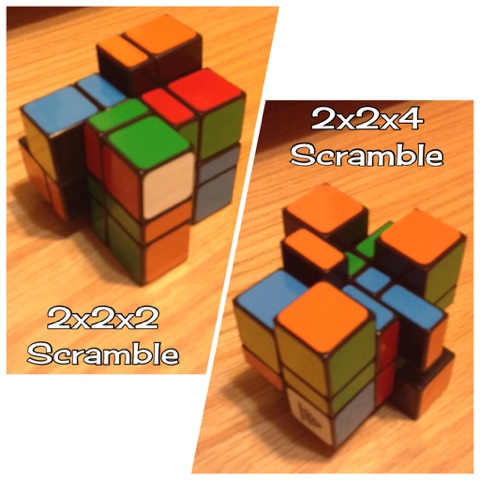
1. Pair up the Orange White Blue corner with the White Blue edge. The Orange White Green corner with the White Green edge. The Orange Yellow Blue corner with the Yellow Blue edge. The Orange Yellow Green corner with the Yellow Green edge.
2. Solve the corners using only 2x2x2 twists.
3. Solve the middle layer edges using the 3x3x2 Corner Commutator.
4. If necessary solve the centers.
Tuesday, August 18, 2015
Witeden 2x3x4 Camouflage Cuboid
I posted recently on the Facebook Puzzle Photography page:


I've had this puzzle for almost a year and made an effort to analyze it months ago but couldn't make enough sense of it to scramble it. Eventually put it away and forgot about it. On the return trip from the CR I got back to it. Since being home I've made good progress in my analysis and have solved it maybe a half dozen times. Here is my approach so far.
Step 3 has two parts. First get the whites and yellows. Use a commutator that goes from one white or yellow piece to a spot that should be to a spot on the side that shouldn't be but is. Or use a commutator that goes from one side edge to one that is white or yellow but shouldn't be, to its home. Use the 3x3x2 corner cycler to put all the non-white/yellow pieces home. Any face can be forward.
Step 4 can be accomplished with a commutator also. I hold 2 on the bottom and one on the top. The one on the top that is the wrong color is in back. The one on the bottom that is the right color is the first one that should be brought to the top. The commutator is a bit different than most:
( Twist D if necessary ) ( r2 U r2 Ui r2 ) ( Twist D one way or the other ) ( r2 U r2 Ui r2 ) ( Twist D if necessary ).
Steps 1, 3, and 4 are becoming somewhat routine now and feeling more and more like most other twisty puzzles in my collection. Step 2 is a big mystery to me at this point. I just keep fiddling with it until I get it, but there is usually some blockage to deal with and I'm not totally sure how I've done it.
From scrambled to almost cuboid took about a half hour. To go from scrambled to solved corners is easy. It took some fiddling and experimenting to get it to almost cuboid shape.
I used 3-cycles to move edges around. Made good progress fairly rapidly but then wandered around in circles near the end. It took an hour and 20 minutes to solve all the edges.
Getting the centers at the end wasn't too hard.
This was my third solve of this puzzle. It was by far the best scramble.
I've had this puzzle for almost a year and made an effort to analyze it months ago but couldn't make enough sense of it to scramble it. Eventually put it away and forgot about it. On the return trip from the CR I got back to it. Since being home I've made good progress in my analysis and have solved it maybe a half dozen times. Here is my approach so far.
- Solve the Corners like a 2x2x2.
- Try to get it to cuboid shape.
- Cycle all the Edges home.
- Cycle the Centers home.
Step 3 has two parts. First get the whites and yellows. Use a commutator that goes from one white or yellow piece to a spot that should be to a spot on the side that shouldn't be but is. Or use a commutator that goes from one side edge to one that is white or yellow but shouldn't be, to its home. Use the 3x3x2 corner cycler to put all the non-white/yellow pieces home. Any face can be forward.
Step 4 can be accomplished with a commutator also. I hold 2 on the bottom and one on the top. The one on the top that is the wrong color is in back. The one on the bottom that is the right color is the first one that should be brought to the top. The commutator is a bit different than most:
( Twist D if necessary ) ( r2 U r2 Ui r2 ) ( Twist D one way or the other ) ( r2 U r2 Ui r2 ) ( Twist D if necessary ).
Steps 1, 3, and 4 are becoming somewhat routine now and feeling more and more like most other twisty puzzles in my collection. Step 2 is a big mystery to me at this point. I just keep fiddling with it until I get it, but there is usually some blockage to deal with and I'm not totally sure how I've done it.
Monday, August 3, 2015
Bandage Kit Cube
I wanted Annie to play with a corners only cube. She had ideas of her own. Pretty soon it was covered with tiles so big it wouldn't turn. We made some slight adjustments and two sides would turn but each blocked the other. After further modifications one layer has two positions that do not block the other turntable layer. And the other does no blocking as it is made up of all 1x1x1 cubies.

It does not scramble very much. The Move and Sune can both be done so it is easy enough to solve the 5 edges. The Move X 3 can be used to do double swaps of edges to permutations the edges. It was challenging to come up with a corner twister for me and the ones I have come up with are pretty long.
At first I could only find ways to twist four corners. I wanted to be able to twist two corners, so I didn't keep track of how to twist four. Now I can twist two, but usually during a solve four or five need to twist once the edges are solved and corners permuted.
A discovery (rediscovery?) made last night is that the edge swapper routine I learned once upon a time done twice in a row does a double swap of corners. Combining that with The Move X 3 twists two corners. Specifically (U R U Ri U R U Ri U) (U R U Ri U R U Ri U) U (R U Ri Ui) X 3 Ui twists FLU anti and BLU clock.
Another way to twist two corners uses Sune. (R U Ri U R U2 Ri U) X 2 R U2 (Ui Ri U R) X 3 U2 Ri twists FRU anti and BLU clock.
Wednesday, July 29, 2015
Dayan Gem V Solution

Here is the complete method as presented on the forum.
1. Get all the centers—small triangles, large triangles, and if you have stickerless v1 as I do, the thin strips on the square faces. All 8 triangles can be solved with either 0, 1, or 4 moves. I do not mean each! I mean that after either 0, 1, or 4 twists all 8 triangles are solved!
The 6 thin strips take me up to 3 Double-EPS, or 24 twists. I use Double-EPS to maintain centers. Rarely it takes three of them. Rarely are they already solved. Usually it takes two Double-EPS to solve all 6 pieces.
2. Place all the small edges (corners) from the bottom up. Uses an Up-Replace-Down technique. Some people call this truncated EPS, since it is the first 3 twists of the EPS.
3. Use [3,1] commutators to solve the large edges.
1. Get all the centers—small triangles, large triangles, and if you have stickerless v1 as I do, the thin strips on the square faces. All 8 triangles can be solved with either 0, 1, or 4 moves. I do not mean each! I mean that after either 0, 1, or 4 twists all 8 triangles are solved!
The 6 thin strips take me up to 3 Double-EPS, or 24 twists. I use Double-EPS to maintain centers. Rarely it takes three of them. Rarely are they already solved. Usually it takes two Double-EPS to solve all 6 pieces.
2. Place all the small edges (corners) from the bottom up. Uses an Up-Replace-Down technique. Some people call this truncated EPS, since it is the first 3 twists of the EPS.
3. Use [3,1] commutators to solve the large edges.
And in an earlier post I said:
doctor twist wrote:
I am left with 3 unsolved center pieces. How you can deal with that?
In my solution outlined directly above, I deal with all 8 of the triangle centers, and all 6 of the thin strip centers of the square faces in step 1, so that I never end up in the situation you describe of being left with 3 unsolved center pieces. My motto: Deal with parity as early as possible so you don't have to unsolve and re-solve at the end.
So, here is how I deal with the centers in a little more detail. Starting with a scrambled puzzle,
1. I hold the puzzle so there is a square face on top, and the large red triangle is on the upper half of the front, and the large purple triangle is on the upper half of the back. This is totally arbitrary, but it is what I am used to looking for and it defines for me the color scheme of the whole puzzle. (It is sort of like when I am solving a Rubik's Cube I start by holding it with the white center on the bottom.)
2. With the Red Triangle in front, I can see 3 small triangles. By looking at these 3 I can tell whether they are solved, or whether they need a double swap, or whether I need to do one twist that will solve them. If the one twist is required I do it. If the double swap is required I do it. (So I deal with the "3 unsolved center pieces" before anything else on the puzzle is solved!
3. Since I have the stickerless version, there are colorful thin strips on the square faces. I place them next using Double-EPS moves. I use Double-EPS instead of just EPS so that the 8 triangle centers don't scramble during this phase. So if I need to move thin strip A to thin strip B to thin strip C, I go the opposite way twice! C to B to A twice is the same as A to B to C, and with each EPS there is a double swap of center triangles, so doing it twice leaves them solved.

So that is how I deal with it. But what if someone handed me a puzzle with everything solved except for 3 triangle centers? Then what would I do? I would do a single twist that solved them, then re-solve the puzzle from there. What a pain! That is why I like to insure at the very beginning that this will not happen.
As I read through the forum topic today some interesting things came out. themathkid originally solved the Dayan Gem V like he solves the Vulcano, Konrad solves it like the F-Skewb, and I originally thought of it like the Jing's Pyraminx.
The thing that got me into this puzzle today is that I left it downstairs where Alex could reach it and Annie brought it to me in pieces. Three pieces had fallen out. She brought the puzzle and the pieces to me upstairs. It popped back together easy enough but I'm not sure the pieces are oriented correctly so I have to solve it to find out. I've solved it a few times already this summer using the abbreviated guide in my spreadsheet, but something told me I had recorded more about it so I went looking and found it at the forum.
Subscribe to:
Posts (Atom)