Sunday, June 22, 2014
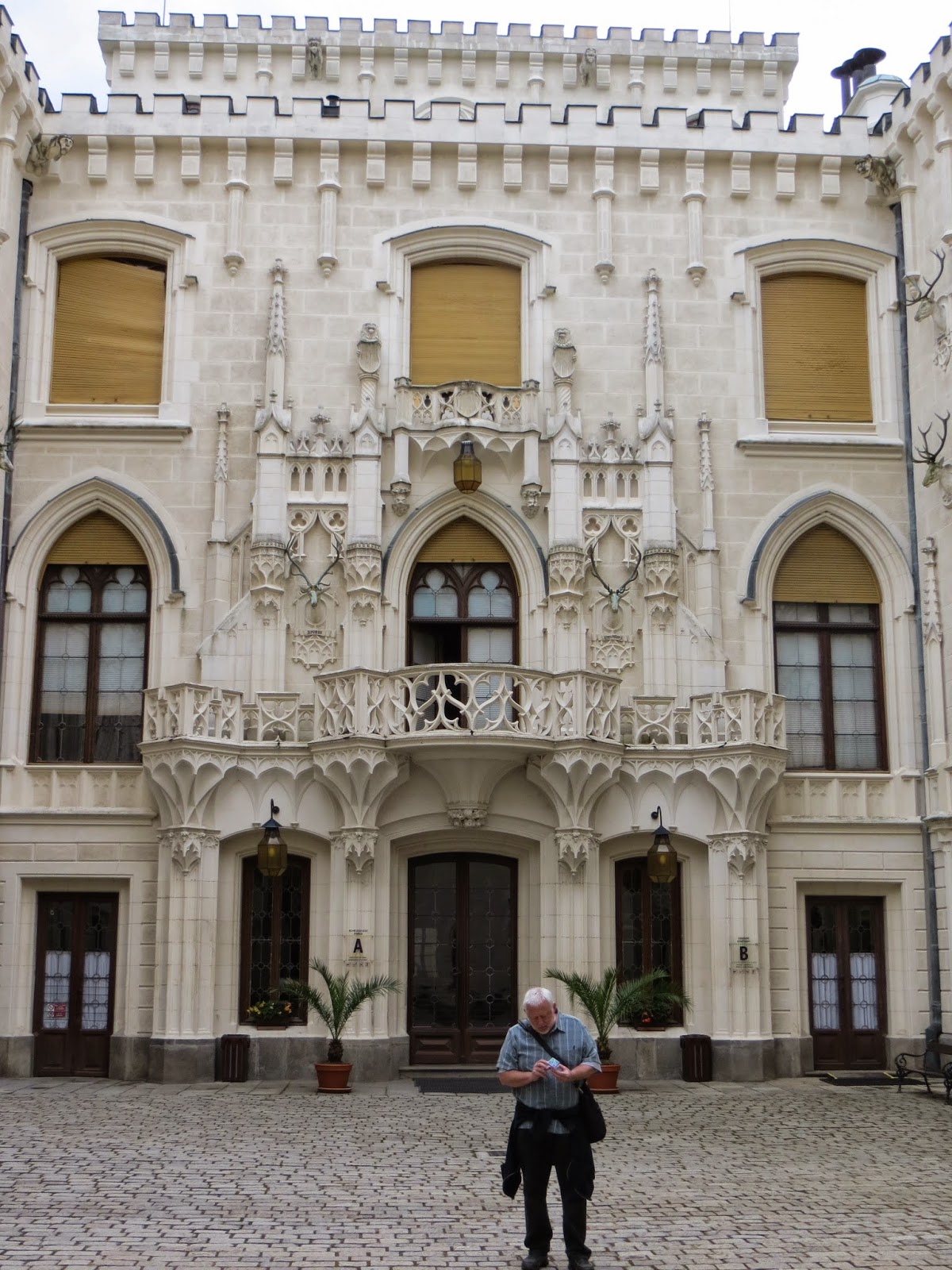
Hluboká Castle
"Bud, don't just sit on that bench trying to remember how to solve your Square-1!"
"All right, I'll move to the other bench. And it isn't just a Square-1. It's a Super Square-1, and I can't get the middle layers back to squares."
"No, no, no. Get up. Go out in the courtyard!"
"Fine. I'm in the courtyard. Happy?"
Seriously, this castle and the grounds around it are absolutely beautiful. These three pictures were taken by my son at my request, but most of the time I was taking pictures and enjoying the sights with my family. Check out my Flickr photo page if you'd like. LINK
And seriously, the Super Square-1 was quite a challenge. Even using the notes I compiled when I first figured it out long ago, it was a challenge. I thought about starting from scratch, looking for another way to solve it, but gave that idea up quickly. I thought about throwing it away. I thought about giving it away. But in the end I worked through my notes and refined them somewhat to make them easier to remember. :D
Alex and the 2x2x1
Alex is focused very seriously on the 2x2x1 while his family (which I graciously cropped out) is clowning around around him.
Thursday, June 12, 2014
Puzzling With Annie in the Garden
We have been visiting our son, Raymond, and his family in the Czech Republic. About 30 or so puzzles accompanied us. :] All my puzzles have been solved at one time or another, but many had not been solved yet in 2014. That is a situation being remedied this summer. It is the Dayan Gem IV's turn today.
One of the puzzle highlights of the summer is an opportunity to show a local young man how to solve a cube. This week we talked about solving the first two layers. He had done so some years back but had forgotten how. Next week perhaps we can review the first two layers and go on to the last layer.
A daily puzzle delight has been puzzling with my 3-year old granddaughter. We have discussed the differences between a cube, a tetrahedron, a dodecahedron, an octahedron, a curvy kite hexahedron, and a truncated octahedron. :] She especially likes the gear puzzles, and is good at identifying which pieces still need solved on all the puzzles. Above she is completing her two-twist solve of the megaminx.
Besides puzzling we had a blast today going to the local zoo and then to a playground for a picnic. I was surprised to see a baseball field at the park. I didn't think Europeans played baseball. The zoo pictures are uploaded to my flickr page.
Monday, June 9, 2014
Prague
Friday, May 23, 2014
Ghost Cube
The Ghost Cube came into my life almost two weeks ago. After the initial greeting, I admired it from a distance for a week. Finally I scrambled it. It was a bugger to find two pieces that went side by side. I was trying to be systematic, but that is really hard. Once though, when I chanced to turn the puzzle around, Bam! A center, edge, and corner had come together without any effort on my part. Yay! A start. As I built my way around the center I had this niggling fear that I might be in for an unpleasant surprise because of the fact that the puzzle when solved is not in 3x3x3 form. Oh, did I mention that during this solve I did not use any reference photos to see what went where? It is now solved and I have several observations.
- This is a hand mod version, not a mass produced version. During the solve I noticed that one of the centers that ends up as a corner of the solved cube, was not made exactly right. The vertex sticks out a little bit further than it should in one direction.
- Two of the centers end up as corners of the solved cube. One of these two should be the starting point of the solve.
- When a weird shaped piece needs to twist in place, I have a terrible time visualizing which way it should go.
- When I do a 3-cycle of corners on a standard cube I know which orientation two of them are going to end up with. Not so with this beast.
I think before I scramble it again I should try some familiar moves and see what happens. Perhaps I can start seeing more clearly, and rely less on try-it-and-see.
May 25, 2014
I have not made any attempt to memorize what goes where, as it seems that would defeat the purpose of the challenge of this puzzle. But after 3 solves I am beginning to be able to see a little more clearly. I still maintain that one of the two centers that end up on a corner of the cube should be the starting point, although I can't tell them apart so don't know if one or the other would be better. I have also developed a favorite edge to start with—the long one that has three surfaces.
I'm getting a feel for which way to twist corners, and I've noticed a difference between the middle layer edges and the top and bottom layer edges.
Although it is making a bit more sense than at first, there is still an amount of "maybe this one goes there" type thinking.
So far I've been using a straight layer-by-layer approach and after the first layer have to shift back and forth a lot between cube form and 3x3x3 form.
When I first learned how to solve a Rubik's Cube, I learned a working corner technique, a layer-by-layer method, a corners first method, an edges first method, some F2L techniques, and even tried the Petrus method. I can not imagine ever being able to solve the Ghost Cube corners first. When solving a cube now it is usually either F2L or Corners First, so I rarely use the algorithm I learned for placing middle layer edges, but now we are becoming good friends. :D Perhaps I should try some of the other methods.
May 27, 2014
Layer-by-Layer works and is the first method I tried since it allowed me to complete a layer at a time, which was important as I was getting used to seeing how the pieces fit together. But the algorithm for inserting middle layer pieces, although I like it as far as algorithms go, seemed unnecessary once I realized the Working Corner method could be used. In the latest solve the Working Corner method worked well. Instead of R'URU' F'U'FU to insert a middle layer edge, it only took something like RUR'. On the last corner and edge I tried to figure out how to join them and insert them together, but couldn't figure it out, so ended up easily inserting the edge, then using a 3-cycle to put the corner in.
For the last layer, whether I used the Layer-by-Layer method or the Working Corner method, I orient edges, place edges, place corners, orient corners.
Recap of methods: The Corners First method is not going to happen on the Ghost Cube. Edges First might work, but inserting the corners in the first layer is not difficult and is a tremendous help visually. At this point in my familiarity with the pieces, F2L would be a matter of finding a corner, keeping track of it while finding an edge, figuring out how to make them fit together correctly, and inserting them together as a pair. Seems to me like it would be a lot harder than the Working Corner method.
Now what? More Working Corner solves in which I try to insert the last corner-edge pair together.
May 28, 2014
It is settled. After considering each of the solving strategies I am familiar with, the Working Corner Method is my strategy of choice for the Ghost Cube.
I did not start this process by studying the pieces of the cube carefully. Just scramble and go. Needless to say that first solve took a long time, involved much trial and error, and I could hardly tell the difference between an edge and a corner! Since then I have looked at the pieces in the solved state and noticed some similarities and symmetries. Very helpful. It is still the most challenging 3x3x3 shape mod I've ever experienced and I still sometimes have a hard time finding the right piece for a particular spot. But there is definite progress. One major breakthrough came by taking a hard look at the middle layer center pieces in solved state. I no longer have to twist centers as many times as I used to, in order to find the correct orientation. In my last solve I was down to the last 4 corners, but when I looked at them I decided it was cute the way it was, so I declared it a new solved state. I give you Ghost Cube Man—
May 31, 2014
I was curious to know how others solve the Ghost Cube, so I asked on the Puzzle Photography page, but did not get much response. Thank you Otis Cheng for sharing your approach. So I messaged rline and Burgo asking specifically how they go about it. rline has a unique method. I tried it a couple times, at least I tried following the sequence of steps. He did not go into detail as to how he did each step. Although I do not enjoy my implementation of his steps, I feel that I learned something from trying nonetheless and have refined my solves somewhat. Here is what I have now—
Most of Layer 1
- One of the two columns made up of a center-edge pair that make up one edge of the solved cube.
- The other 3 edges around this same center.
- 3 of the 4 corners around this same center.
Use the Working Corner to solve the Middle Layer
- Use the working corner to orient the middle layer centers one at a time.
- Use the working corner to solve the middle layer edges.
- When the middle layer is complete solve the working corner corner.
Last Layer
- Orient edges.
- Permute edges.
- 3-cycle corners.
- Orient corners.
As I have mentioned previously, the middle layer centers can give me fits. Some things I have learned that can be helpful—
Each has a triangle side. The triangle sides of the correct two adjacent centers can be oriented to lie on a plane. The triangle sides of the other two centers lie on a parallel plane. The hexagon shaped pieces go between these centers. The smallest triangle and the largest triangle go together, but if you forget to check that and are just trying to find which two work together, and two look like maybe they are on a plane, but neither hexagon piece will work with them, those centers need to be on the top of the middle layer rather than the bottom.
Thursday, May 22, 2014
6x6x6 Solve—A Surprise
Introduction
Kevin and I have been going back and forth discussing ways to solve the 6x6x6 in which parity is not a problem. There have been references to SuperAntonioVivaldi and Twisty Puzzling and their methods. I made an attempt to utilize some of their techniques to come up with a way to solve the 6x6x6 in a different way than I normally solve big cubes. In the end I decided my old method suits me best.One Last Experiment
Kevin's focus in solving the 6x6x6 without parity is to reduce it, not to a 3x3x3, but to a 2x2x2. Today I thought it would be interesting to use my old method, with a minor change, to do just that. When solving the corners early in the solve, instead of orienting and permuting them, I would only orient them. Then when solving the rest of the puzzle using my old method, I would solve to the corners, wherever they happened to be. In other words, I would use my old method to reduce the 6x6x6 to a 2x2x2. It complicated things a bit both visually and in eliminating some shortcuts and options during the solve, but it is pretty much using my old method to reduce the 6x6x6 to a 2x2x2. See for yourself.![]() |
| Scrambled |
![]() |
| White and Yellow Centers |
![]() |
| Corners Oriented |
![]() |
| Fill in 3 of the 4 White Edge Rows |
![]() |
| Fill in 3 Yellow Edge Rows |
![]() |
| Insert Last Yellow Edge Backward into Whites |
![]() |
| Solving White Solves the Yellow Too |
![]() |
| Middle Layer Edges on the White Half of the Puzzle |
![]() |
| Middle Layer Edges on the Yellow Half |
![]() |
| Making Progress on Centers |
![]() |
| Almost There |
![]() |
| Centers Solved |
![]() |
| 2x2x2 Solved |
Thursday, May 15, 2014
6x6x6 Swapped Edges
I solved this puzzle a couple times using the same approach as with a 4x4x4—
There is never a parity issue when doing it this way. Never. But then I read that Kevin Sadler has a different way of solving it that also avoids parity. I tried following his outline but obviously did something wrong because at the end it looked like
- White and Yellow Centers
- 8 Corners
- White and Yellow Edges
- Middle Layer Edges
- Middle Layer Centers
There is never a parity issue when doing it this way. Never. But then I read that Kevin Sadler has a different way of solving it that also avoids parity. I tried following his outline but obviously did something wrong because at the end it looked like
Monday, May 12, 2014
Four Newish Puzzles
Earlier this spring our house was broken into during the day. Among other things about half my puzzle collection was stolen. Around 40 puzzles. You know, twisty puzzles. Like Rubik's Cubes.
Today in the mail I received a box from overseas with 4 puzzles:
A new Buzzle Ball. I scrambled it once and managed to solve it using primarily the fiddle around trying to figure it out method. I'm looking forward to getting better acquainted with this strange new twisty puzzle.
An old flat-sided V-Cube 6 that probably hadn't been used very much because it isn't very easy to turn. From what I've seen online the new pillowed V-Cube 6 is much much better. I've never had a 6x6x6 cube, so it is nice to have one now. Among the puzzles stolen was a V-Cube 7, an Eastsheen 5x5x5, and a variety of 4x4x4's. So the old V-Cube 6 is my one and only big cube now. I like the weight and size and shape of it and plan to have more fun with it whenever I get the urge to solve a big cube.
A 2x2x2 cube. My old 2x2x2 cube was stolen! The Rubik's Ice Cube in the drawer doesn't even count as a 2x2x2 as far as playability goes. It is nice to have a good 2x2x2 again. It seems to turn better than the Eastsheen I had, too.
A Hungab Ghost Cube. I've seen some of the Ghost Cube hype online, but didn't think I would get one. I've been in a bit of a slump puzzle-wise for several months. I bought an Evil Eye 2 months ago and only got around to playing with it this month. When a puzzle friend from around the world offered to give me a Ghost Cube, along with the other 3 puzzles, you can imagine that my interest in Ghost Cubes spiked! This thing is beautiful.
Thursday, April 24, 2014
Squirrel Friends
A colleague at CTB introduced me to her squirrel friends. Today I had a good chance to share lunch with them. Sitting on the backseat of my car with my feet on the ground, I held a piece of peanut butter sandwich where the squirrels could take it out of my hand if they would come up to me. A couple of them did.
Monday, February 17, 2014
Curvy Rhombohedron Skewb
The first couple solves I just started putting pieces together that looked like they needed to be put together. Eventually a 3-cycle or a twist or two needed to be done to finish up and I drew from my Skewb Family Arsenal of Algorithms (I just made that up).
But then Kevin asked how I solve the Skewb, so I got out the Skewb Cube and solved it. Then the Tetrahedral Skewb. Then the Squished Skewb. Then I intentionally tried to use the same strategy to solve the Curvy Rhombo Skewb.
Documented Scramble #1: DNF
After getting the first 8 pieces solved, leaving only 6 to go, the thing still looked scrambled! After using a setup move and the 3-cycle to place 2 of the 6 pieces, and not being able to see how to undo the simple setup move, I decided that although it is possible to solve in the same way, a more intuitive approach would be better.
Documented Scramble #2:
After solving the yellow layer, including the green and purple triangle center pieces, one twist of the black layer was needed to solve the 3 remaining triangle center pieces. That left the 3 remaining edges out of place and the remaining corner twisted. After using Double-EPS to place the edges instead of the pure 3-cycle, both of the diagonally opposite corner pieces needed twisted. I don't think it is possible to twist them together, so I twisted each one with a triangle using an algorithm that hadn't been used in any of the previous posts' solves. I will not even attempt to type it out.
So it turns out I not only demonstrated the algorithm. I also showed what happens when unexpected results happen, and one way to solve mysteries! :D
Documented Scramble #3:
Very difficult to get the yellow layer this time. The first several times I tried it this way it seemed almost trivial to get a layer solved. But this time, either it was a different scramble, or my mind wasn't in sync with the puzzle as before. This can be a problem when solving intuitively rather than with a systematic strategy. I ended up using Triple-EPS a couple times to swap pieces into place on the yellow layer.
After solving most of the black layer as described in #2, once again I ended up with the 2 small corners twisted. Two lessons to learn. First, if I would use the same steps as I do with other Skewb puzzles, I wouldn't have this problem at the end. So is it worth it to work through a more visually challenging solve at the beginning to make the endgame go more smoothly?
Secondly, it dawned on me that one conclusion I made in #2 above is incorrect. I said "I don't think it is possible to twist them together," because one is in the corner role and the other in the center role (thinking of the Tetrahedral Skewb). But what did I learn in the video above? I can twist 1 corner and 3 triangles, in the unshapeshifted puzzle, and 2 of the triangles are centers! So I can twist a corner and a center together! Yay!
In conclusion... well, is it ever really concluded? Let's just say that after several more solves I have decided that at this point I rather like solving it using the same basic approach taken with the other Skewb Family puzzles. That is, get the 2 small corners and the 6 triangles first. This only takes a few simple twists. Maybe 1 EPS. So with half a dozen twists or less more than half the puzzle is solved! Then 3-cycle the 6 big pieces home.
If a corner needs twisted without disturbing triangles, up twist down replace up twist-the-other-way down go-back works well and is pretty simple. Let's see.
Bottom line though, with this puzzle, as with any puzzle, there is no right or wrong, easy or hard, better or worse, way to solve it. I may decide on a favorite way to solve it tonight, but 6 months from now pick it up and take a whole different approach. I suppose I should demonstrate the Preferred Method applied to this one, so
Documented Scramble #4:
Sunday, February 16, 2014
Squished Skewb Solve
I think the Squished Skewb is great! The shapes you can make with it are fun and interesting. The quality of the puzzle is very good (thank you LanLan). Here is a solve.
In this solve the corners only took a couple twists plus one EPS. None of the corners needed to twist after being placed. That scenario was covered in the Skewb Cube video and works the same with the Squished Cube.
Meier-Halpern Pyramid (Jing's Pyraminx)
In the previous post I showed a solve of the Skewb Cube. The Meier-Halpern Pyramid corners can be solved like the first 4 corners in the Skewb video, with just a few simple twists. If the centers are not solved they can be solved with one EPS. Or, if preferred, the centers can be solved later using a Triple-EPS.
Now the edges may be solved with the same algorithm as the Skewb center squares, but there are easier ways. For example, the EPS can be used to place them if centers are going to be solved last, or the Double-EPS can be used to place them if the centers are already solved. So it just depends on whether you like having the centers and corners all solved first, or not. Why can this simpler method be used here, but not with the Skewb Cube? Because it twists the centers of the Tetrahedron, which doesn't matter, unless orientation of the centers matters to you. It doesn't to me. I ignore the grain of the stickers. If it matters, the longer algorithm demonstrated in the Skewb Cube video works.
Finally, if a pair of edges need flipped, without disturbing the rest of the puzzle ,,,
How I Prefer Solving a Skewb
Now that I've watched it, I have one thing to say. When twisting two corners, they have to need to twist opposite directions. Don't try to use this method to twist two corners in the same direction. It won't work. But you probably knew that already.
Monday, January 20, 2014
Six Flags Discovery Kingdom January 2014
Six Flags Discovery Kingdom January 2014, a set on Flickr.
What a fun day we had with Rory, Rebecca, Roark, Roriana, Robert, and Jaci. It was the best ever elephant show I've ever seen, showing what kind of work Asian Elephants do in the real world. The dolphins were very impressive, and looked so happy! :D And the tigers. I've never seen tigers do anything besides lay around or pace.
Saturday, October 26, 2013
R&R_Twisting
The highlight of the field trip for me was the ride to and from. The whole day was good, especially since R&R were along.
Tuesday, October 22, 2013
Free
I have recently been watching a series of 4 messages online. It starts out by posing:
And then he tells what the problem is and how to fix it.
Want to know more? Go to Free. If it isn't on Part 1 click the 1 button at the bottom.
It’s difficult to solve a problem when you don’t understand what’s wrong to begin with. Many of us have been trying to solve the problem of “us” for a long time. Some of you have lost friends, family, or jobs because you couldn’t solve you. Some of you have paid someone good money to solve you. But what if the real problem is that you don’t know what the problem is?
And then he tells what the problem is and how to fix it.
Want to know more? Go to Free. If it isn't on Part 1 click the 1 button at the bottom.
Saturday, July 27, 2013
Subscribe to:
Posts (Atom)